We're launching the full database soon!
Subscribe to get the latest updates. Our CEO also runs a weekly newsletter.

A data centre that reduces its grid power draw for a small share of the year can potentially connect years earlier. Grid operators across Europe and US are starting to reward this, and some are beginning to require it.
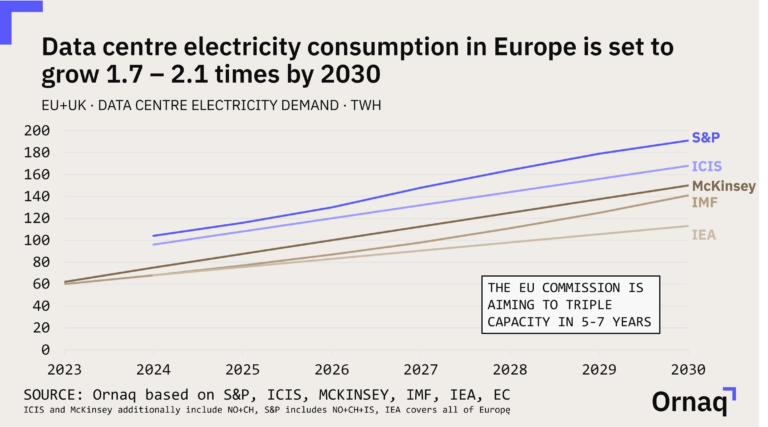
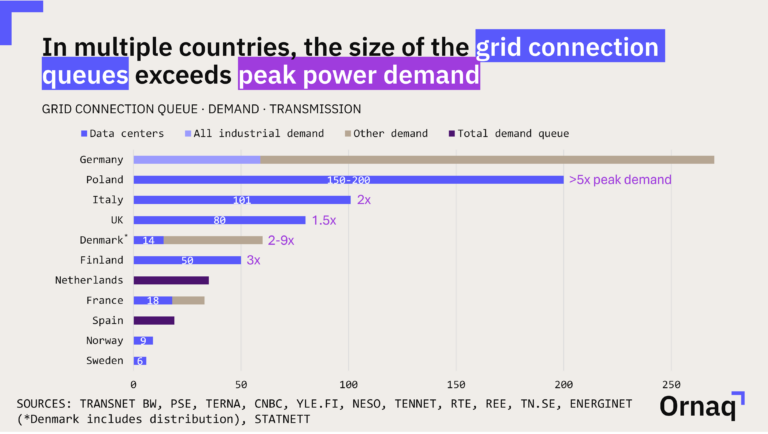
Grid connection queues for new loads now exceed national peak demand in at least five European countries. Grid operators are responding with stricter prioritisation rules, and flexibility is becoming one of the criteria.
Not all data centres need not run at their full grid power rating in every hour of the year. Often, they take multiple years to scale to nominal capacity, and even then, the load can be controlled to an extent. Finally, reducing grid-power draw doesn’t need to impact IT loads, if on-site assets like battery act as a buffer.
Reducing the grid power draw in a small share of hours in the year has a disproportionate effect on how much grid capacity is available.
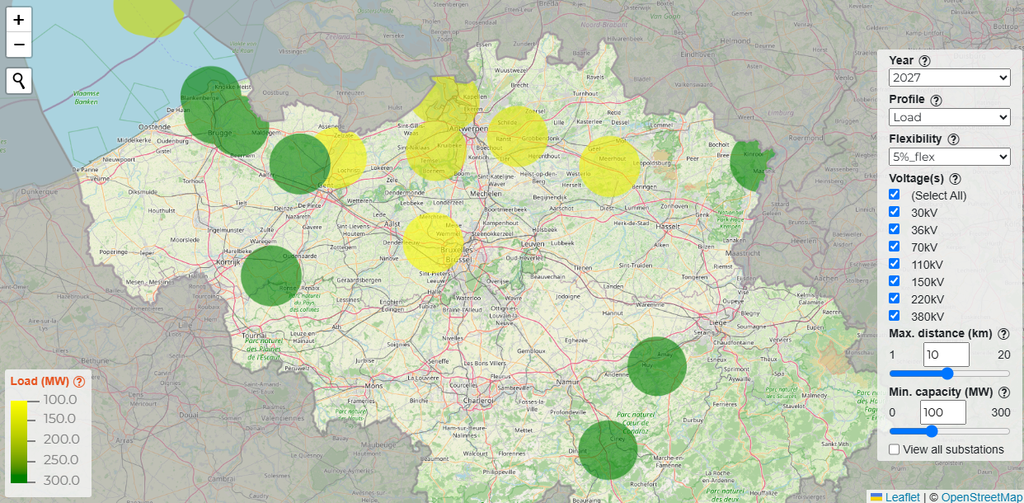
In Belgium, the transmission operator Elia publishes hosting capacity maps showing where new load can connect. For 2027, there is a single location in the country able to host a 100 MW data centre. Grid reinforcements open up nine more by 2031. But if 5% demand flexibility is allowed, through the shifting or reduction of load, or by covering it with on-site generation, the same map shows 16 available grid connection points, many able to take up to 300 MW.
Five percent of the hours in a year is around 18 days, which is not tolerable for most data center operators. However, data from Ireland and Norway shows data centres are drawing only around 30% of their contracted grid capacity, blocking the remaining 70% for future expansion. The largest projects typically start at 10-20% of nominal power and take multiple years to reach full output. A phased connection, which grants a smaller connection quickly and scales over one to three years, can offer a win-win: better speed-to-power for the data centre, and more efficient use of the grid.
A trial by Nebius, Emerald AI, EPRI and National Grid on a live AI cluster in London cut load by 30% within 40 seconds of a grid stress signal. It sustained 10-hour reductions of 10-40%, while delivering 99% performance on the highest-priority workloads. Academic work finds that AI clusters can reduce power draw by 20-50% over short intervals without breaching service-level agreements. Google reports 1 GW of demand response across its fleet.
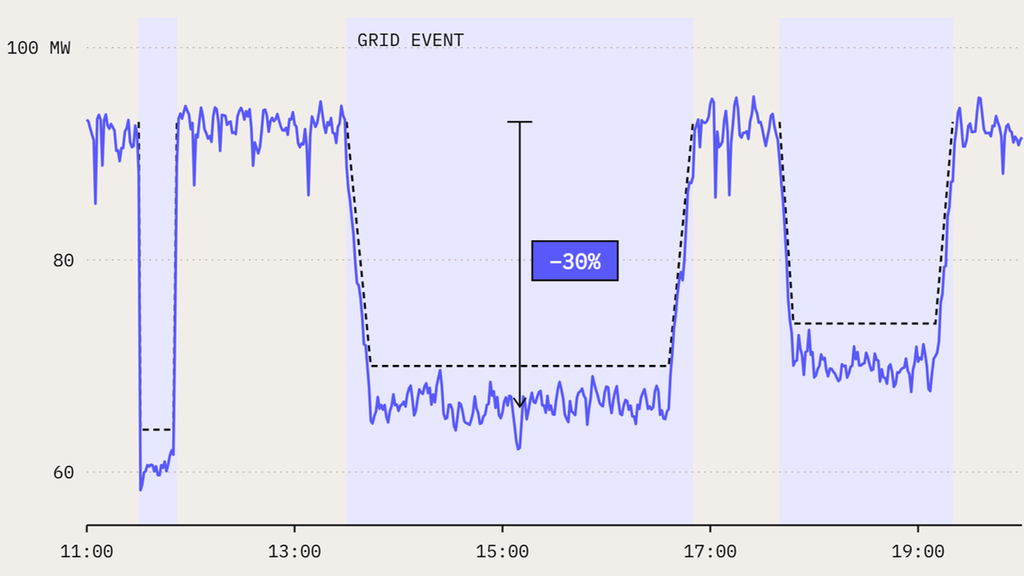
This shows that technically, more flexible management of IT loads is already possible.
But flexibility doesn’t have to impact IT loads at all. On-site batteries and solar can reduce the draw from the grid while keeping the data centre fully energised. In a hypothetical redesign of xAI’s Colossus site, coupling on-site clean power with flexibility – curtailing IT load by 25% in 200 hours a year when the grid is above 90% of peak (2.3% of the time), would have supported a faster grid connection and a much smaller gas fleet.
A study by Camus, encoord and Princeton’s ZERO Lab modelled six sites with under 1% annual curtailment and temporary compute flexibility of up to 25%, combined with on-site generation and storage. Connection times fell from 5-7 years to 2 years. At around $8 million of revenue per MW per year, three extra years of operation are worth $2-5 billion per site, or $1-4 billion if the cost of the on-site assets is included.
Flexibility unlocks grid benefits too, reducing peak load, which directly translates to grid investments into substations and lines – funded through consumer bills.
The EU’s 2024 electricity market design reform added Article 6a to the Electricity Directive, obliging regulators to set frameworks for flexible connection agreements where network capacity is limited.
National approaches differ widely. Some operators offer flexibility as a voluntary route to an earlier connection, but others are moving to make it an obligation for the largest loads.

A note on the data. The instruments in the table are not directly comparable. Some are general products for all large loads, others target data centres specifically, and several are still proposals. Status is as of October 2026.
Three patterns emerge. The Nordic and Dutch operators have the longest experience with conditional access, mostly designed for industry and now applied to data centres. The UK, Ireland, Finland and Texas are moving fastest towards mandatory flexibility for the largest loads. And Ireland stands apart by requiring firm, dispatchable on-site capacity rather than load flexibility as such.
The EU-level policy lags behind national practice. The Commission’s Strategic Roadmap for digitalisation and AI in energy calls data centres “good candidates” for flexible connections but leaves the design to Member States. In the AI Gigafactory tender, grid-aware flexibility counts for just 0.4% of the technical score. The newly introduced rating scheme recognizes flexibility as part of the data centre energy label, but it remains to be seen whether that becomes required by the upcoming minimum performance standards.
The barriers are now commercial and regulatory rather than technical.
Products designed for other loads. Many existing instruments were built for electric boilers, electrolysers or storage. Denmark’s limited grid access applies only to loads running fewer than 500 full-load hours a year, which rules out almost any data centre.
The flexible share of AI load may shrink. Training workloads can be paused or shifted; inference cannot easily be. As the Friedrich-Ebert-Stiftung notes, operators prioritise inference to meet service-level agreements, and inference is assumed to be the bulk of compute demand.
Flexibility from fossil backup. The easiest way to make a data centre “flexible” is to switch to on-site diesel or gas generators during grid stress. This meets the letter of a flexibility requirement while increasing local emissions and air pollution. Rules need to specify which resources are prefered as flexibility providers.
Verification. A flexibility commitment is only as good as its enforcement. Without metering access, defined baselines and penalties for non-delivery, operators cannot rely on flexibility when they plan the grid – and the main benefit of a flexible connection is lost.
Transparency. Belgium is one of the few countries publishing capacity maps that show the effect of flexibility. Without such data, developers cannot weigh a flexible connection against a firm one in a different location.
Flexible connections are among the cheapest and fastest ways to integrate new data centres into the grid. The following measures would help regulators and system operators make full use of them.
While these measures can already be applied at national level, a consistent pan-European approach would lower costs and give developers a single set of rules. The implementation of Article 6a, the Cloud and AI Development Act, the Minimum Performance Standards for data centres and the AI Gigafactory selection are all opportunities to give flexibility real weight – and move towards grid-positive data centres in Europe.