We're launching the full database soon!
Subscribe to get the latest updates. Our CEO also runs a weekly newsletter.

Data centre electricity consumption is growing, which is being widely covered by the media. However, the forecasts vary, and even historical values carry a lot of uncertainty.
Consultancies such as ICIS and S&P put the EU+UK data centre power consumption at around 100 TWh already in 2024. The IEA’s number for the whole of Europe is a much lower 68 TWh. The latter figure is cited by the European Commission in policy files, such as the September 2026 communication on the data centre rating scheme, mislabeled as “EU” rather than the wider IEA definition of Europe (EU, Albania, Belarus, Bosnia and Herzegovina, Gibraltar, Iceland, Israel, Kosovo, Montenegro, North Macedonia, Norway, Republic of Moldova, Serbia, Switzerland, Türkiye, Ukraine and United Kingdom).
The above shows how much divergence there is even in tracking historical data centre electricity consumption.
For now, we’ve decided to use the IEA numbers because of the methodology – the IEA tracks server shipments, assigning them to regions and arriving at a “bottom up” electricity consumption figure. The typical alternative is to track the declared capacity of data centre buildings, and assume some level of utilization. However, as we’ve seen in multiple cases, very often sites take multiple years to reach their design capacity (or grid capacity), meaning the latter approach oven overestimates actual power consumption.
Another argument behind the choice of the IEA figure is a calibration performed using national sources.
In the case of the Netherlands, the Dutch Statistics Office estimates 5.1 TWh of data centre power consumption in 2024, against an ICIS estimate of 8.4 TWh. For the UK, an official figure of 4.5 TWh in 2024 is almost 3 times lower than the ICIS estimate of 12.6 TWh. Another figure was reported by the grid operator NESO: 7.6 TWh in 2024, still much lower than the ICIS number. The ICIS figures match well with the official statistics for Ireland (6.8 TWh vs 7 TWh), arguably the best documented market, which also allows for better calibration of models.
The differences can stem from various reasons – the methodology, the quality of the data coverage, the inclusion of enterprise data centers (a large fleet of small, privately owned facilities that fall below the regulated data reporting requirements). In fact, IEA assumes a drop in utilisation factors, and a drop in the PUE, both contributing to lower power consumption per unit of capacity. It also tracks a lower capacity (12 GW) compared to EUDCA (14.8 TWh), likely due to the lack of small enterprise data centres.
As we work on our own estimates, we will temporarily use the IEA figures as a baseline value.
The uncertainty grows as we move from historical data estimates to forecasting the future.
Several forecasts of data centre electricity demand are available. They vary on geographical coverage and on methodological aspects, which partially explains the different starting points – from ~70 TWh for IEA, IMF and McKinsey, to the ~100 TWh for the abovementioned ICIS and S&P.
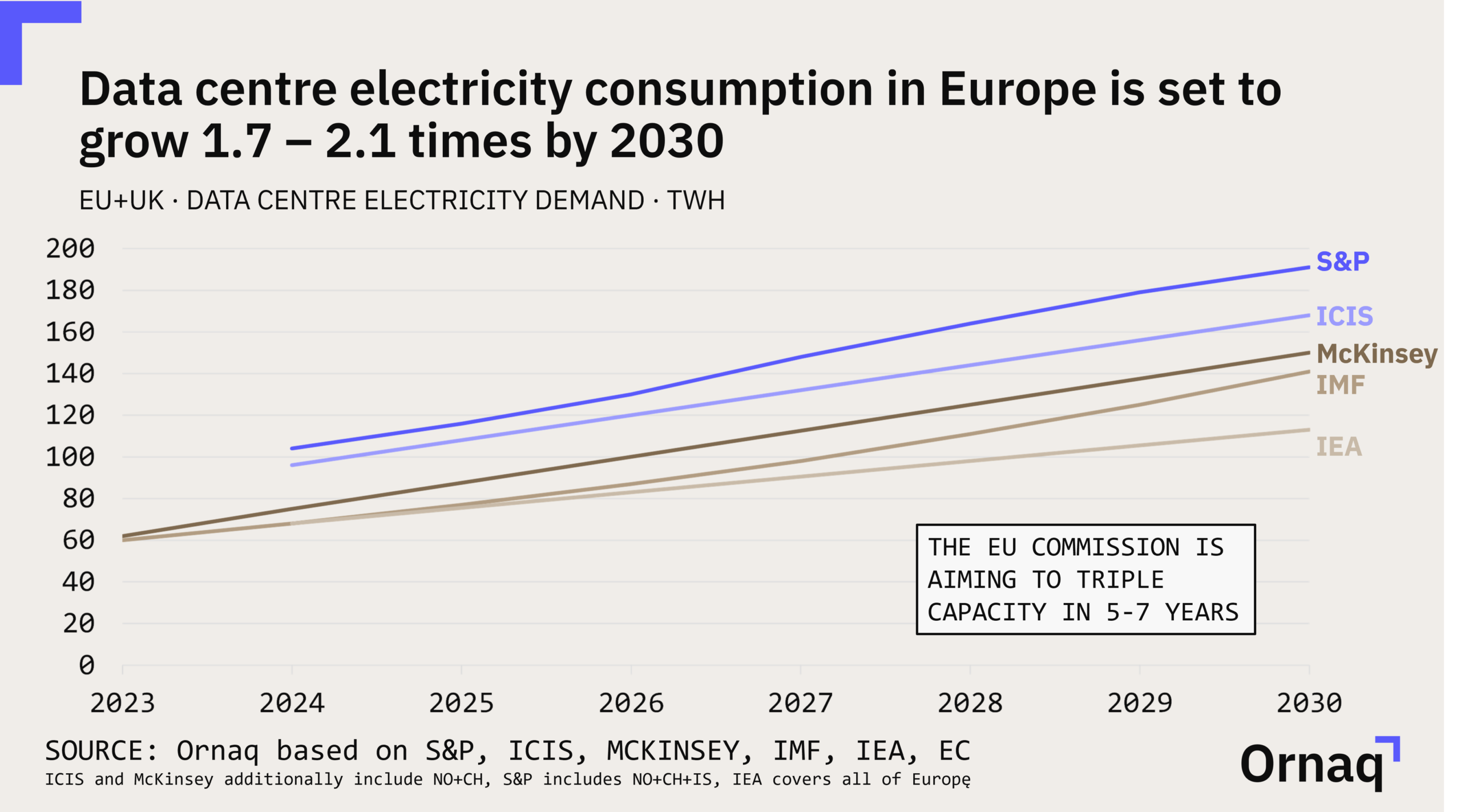
The 2030 values range from 113 to 191 TWh. There is, however, a consistency around the pace of change: all the forecasts fall between 1.7 and 2.1x growth rates from 2024 to 2030.
While the baseline carries some uncertainty, there is a common understanding that the electricity consumption from data centres in Europe will roughly double by 2030. This means the bloc is unlikely to reach the EU’s target of tripling data centre capacity in 5-7 years – unless the consumption growth lags behind capacity (which, as described above, is somewhat to be expected).
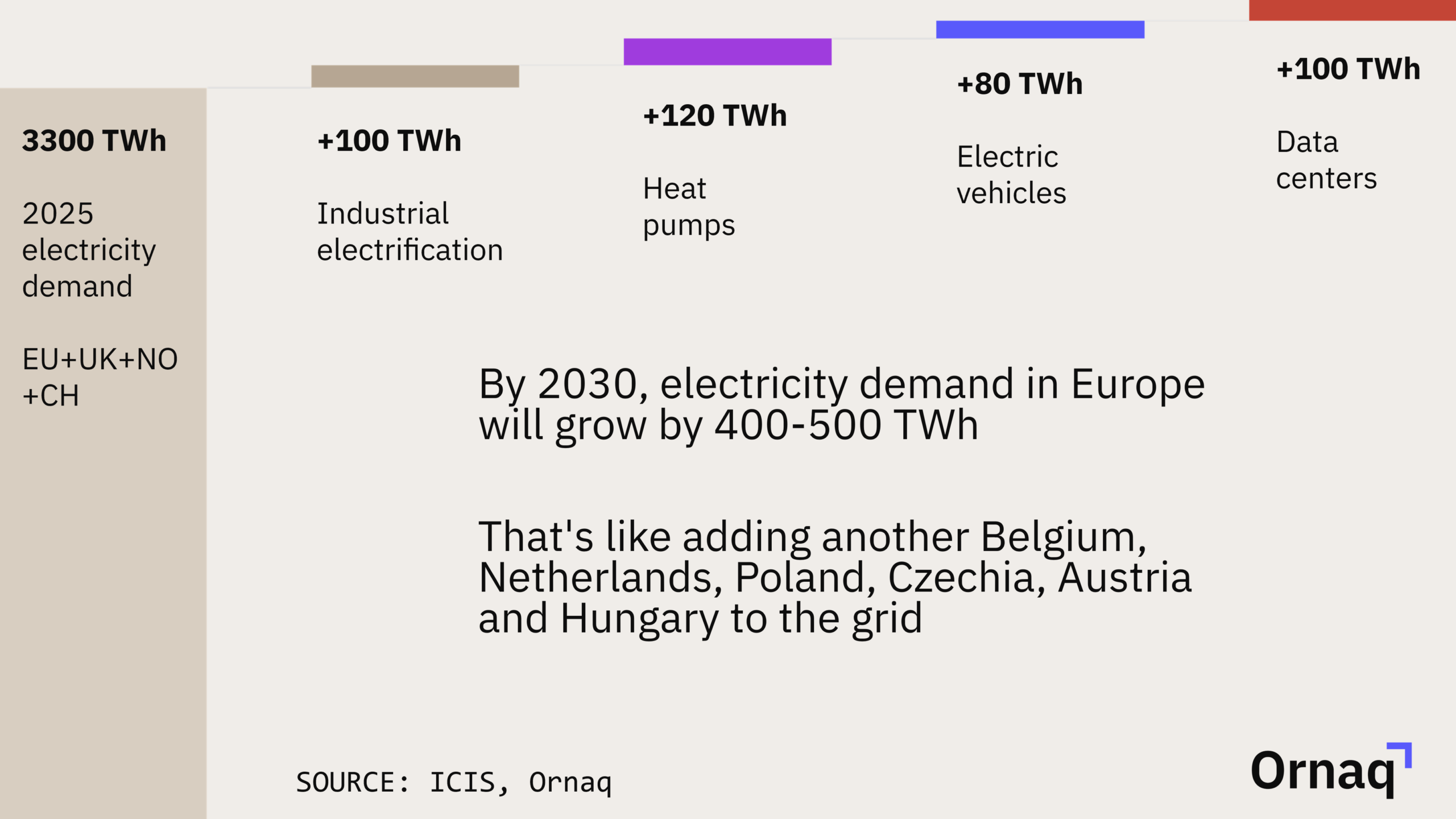
Even assuming an expansive scenario in which data centers add 100 TWh of new electricity consumption by 2030, this will still be a small portion of Europe’s total power. In 2025, the continent consumed 3300 TWh, with data centres being around 2% of that. By 2030, this share is unlikely to exceed 5.5%.
However, it’s important to look at the wider electricity consumption picture. Together with the electrification of industry, heating and transport in Europe, the total demand growth is estimated at 400-500 TWh by the early 2030s. This means the continent will be adding the equivalent of several countries to its power system.
The single digit demand growth seen in Europe stands in stark contrast to the global average of 17% in 2025. The gap with the United States is even wider, where data centres electricity demand was estimated to have grown 22% in 2025.
This means that the share of Europe in the global data centre market will likely be decreasing – from 18% in 2023 to 15% in 2025 and 12% in 2030, according again to the IEA.
While data centre electricity consumption has drawn a lot of attention in the recent years, robust data is scarce, and the available figures vary significantly.
Improving the quality of both historical data and future forecasts is essential for both policymaking and investment decisions. The biggest lever might be national: more European countries could follow the route of Ireland and the Netherlands and publish electricity consumption figures, improving the Europe-wide estimates as well.