We're launching the full database soon!
Subscribe to get the latest updates. Our CEO also runs a weekly newsletter.

An overview of EU legislation related to data centers
Last updated: September 23, 2026
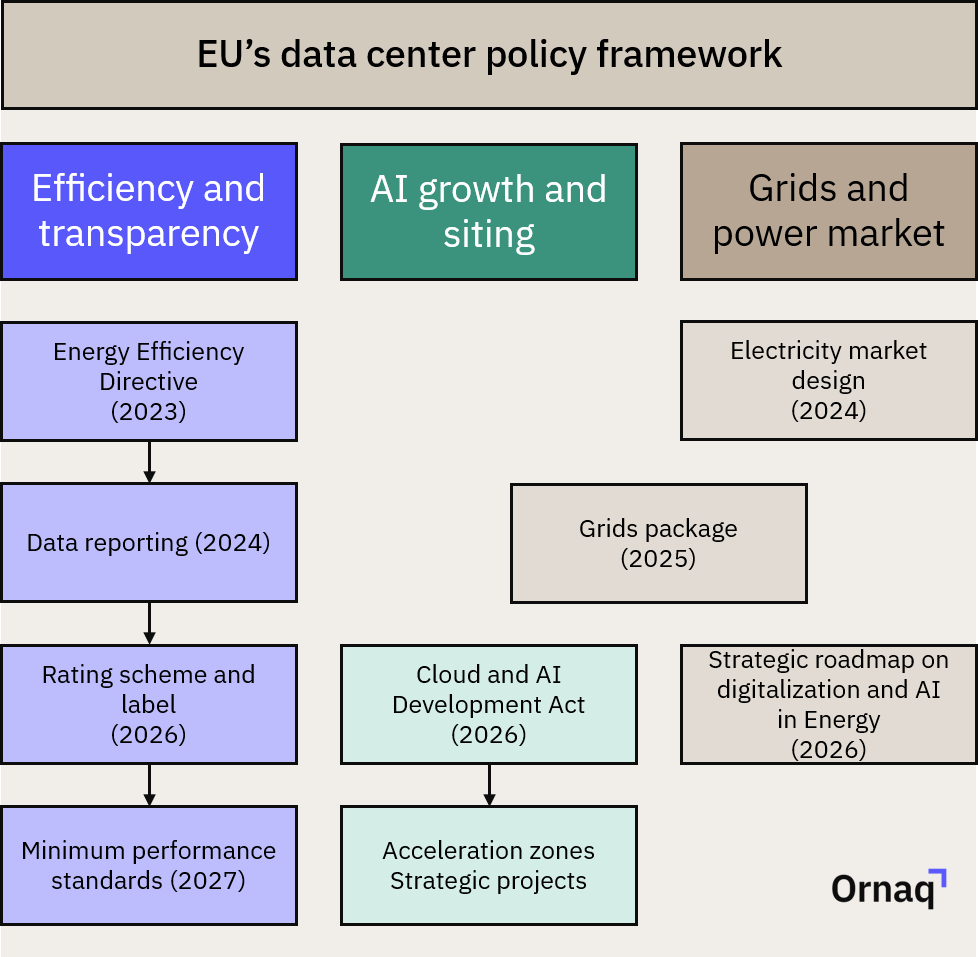
In force, September 2023
Directive (EU) 2023/1791 of the European Parliament and of the Council of 13 September 2023 on energy efficiency and amending Regulation (EU) 2023/955 (recast)
The main relevant points are:
However, there’s a disclaimer: “except for information subject to Union and national law protecting trade and business secrets and confidentiality”.
There’s also Art. 26 (6): data centres with energy input above 1 MW must use waste heat or other waste-heat recovery applications, unless technically or economically infeasible. That last part is again a loophole, and leaves space for Member States to properly enforce it.
In force, March 2024
Commission Delegated Regulation (EU) 2024/1364 of 14 March 2024 on the first phase of the establishment of a common Union rating scheme for data centres.
This created the European database on data centres and the KPI set: energy, water, waste heat, renewables, ICT capacity and data traffic.
Reporting deadlines are on 15 May every year.
First-round, reported in COM(2026) 500, shows mixed results: only about 36% of the estimated in-scope data center population reported data. Six Member States reported zero data centers, and five Member States have reported less than 3. 70% of the reported data was assessed to be reliable.
Individual-site data was confidential. Only aggregates were published.
Adopted by Commission (September 2026), waiting for EP and Council
COMMISSION DELEGATED REGULATION (EU) of 21.9.2026 supplementing Directive (EU) 2023/1791 of the European Parliament and of the Council and amending Commission Delegated Regulation (EU) 2024/1364 as regards the establishment of a common Union rating scheme for data centres
Adopted on 21st September 2026, it’s now subject to 2-month scrutiny by the European Parliament and the Council before entering into force.
Proposes the data center label, assessing data centers on energy and water efficiency, clean power use, but also flexibility and waste heat reuse.
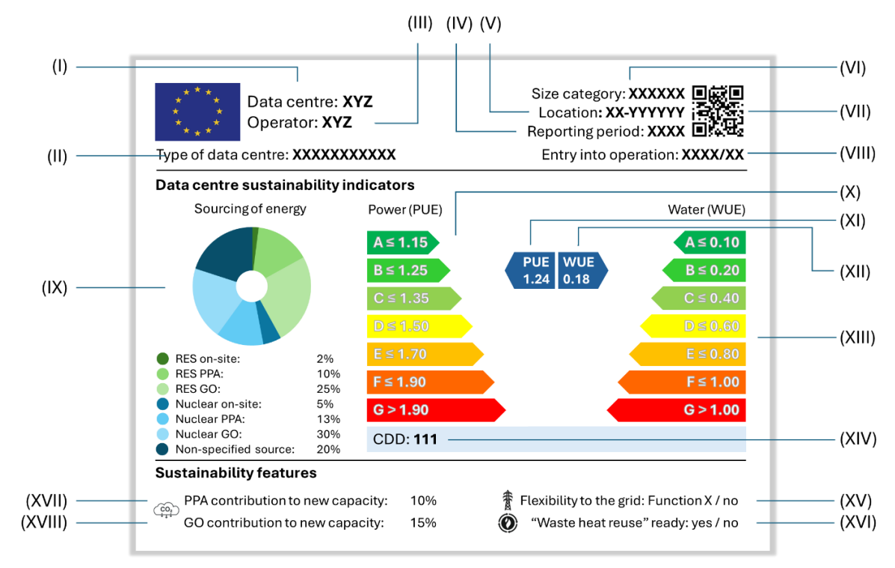
The first labels will be generated by 15 August 2027, then updated annually. Labels will be public.
The label structure is shown above.
Call for evidence, September 2026
Call for evidence and open public consultation for the establishment of minimum performance standards for data centres in Europe
The impact assessment is scheduled for later in 2026, the call for evidence closes 14 December 2026, with Commission adoption scheduled for Q2 2027.
This is the third step after the data reporting and the labels, actually implementing requirements on data center design and efficiency. It will require new or retrofitted data centers to meet minimum levels for energy efficiency, water use, waste-heat reuse, services to the grid and other criteria.
Proposal, June 2026
Proposal for a REGULATION OF THE EUROPEAN PARLIAMENT AND OF THE COUNCIL establishing a framework of measures for strengthening Europe’s cloud and AI ecosystem (Cloud and AI Development Act)
The proposal from June 2026 sets an overarching goal to at least triple EU data center capacity in the next 5-7 years. The exact numbers are not clarified – on both the timeline and the capacity scale-up.
CADA introduces Acceleration Zones similar to RAAs:
Separately, CADA introduces Strategic projects, that benefit from a faster permitting process, if they meet criteria like improving grid stability (projects with co-located clean power and storage), meeting public sector functions, supporting European manufacturing of chips.
In force, June 2024
Directive (EU) 2024/1711 of the European Parliament and of the Council of 13 June 2024 amending Directives (EU) 2018/2001 and (EU) 2019/944 as regards improving the Union’s electricity market design (Text with EEA relevance)
and
Regulation (EU) 2024/1747 of the European Parliament and of the Council of 13 June 2024 amending Regulations (EU) 2019/942 and (EU) 2019/943 as regards improving the Union’s electricity market design (Text with EEA relevance)
It obliges Member States to set up flexible connection frameworks (Art. 6a in the Directive).
In force, December 2025
COMMUNICATION FROM THE COMMISSION TO THE EUROPEAN PARLIAMENT, THE COUNCIL, THE EUROPEAN ECONOMIC AND SOCIAL COMMITTEE AND THE COMMITTEE OF THE REGIONS
The Grids Package is only partially relevant, but it recommends moving from first-come-first-served to first-ready-first-served connection queues, and adding “use it or lose it” rules (so you’re grid connection might be reduced if you’re not using it in full). Plus calls for the implementation of capacity maps and flexible connections.
In force, June 2026
COMMUNICATION FROM THE COMMISSION TO THE EUROPEAN PARLIAMENT, THE COUNCIL, THE EUROPEAN ECONOMIC AND SOCIAL COMMITTEE AND THE COMMITTEE OF THE REGIONS Strategic Roadmap for Digitalisation and AI in the Energy Sector
The flagship action is a a model tripartite agreement (data centers, grid and energy actors, public authorities) that covers grid-planning information, siting, transparency of connection requests, PPAs, flexibility, waste heat and flexible connections.
It also set the timeline for the rating scheme and MPSs.